
The Setup
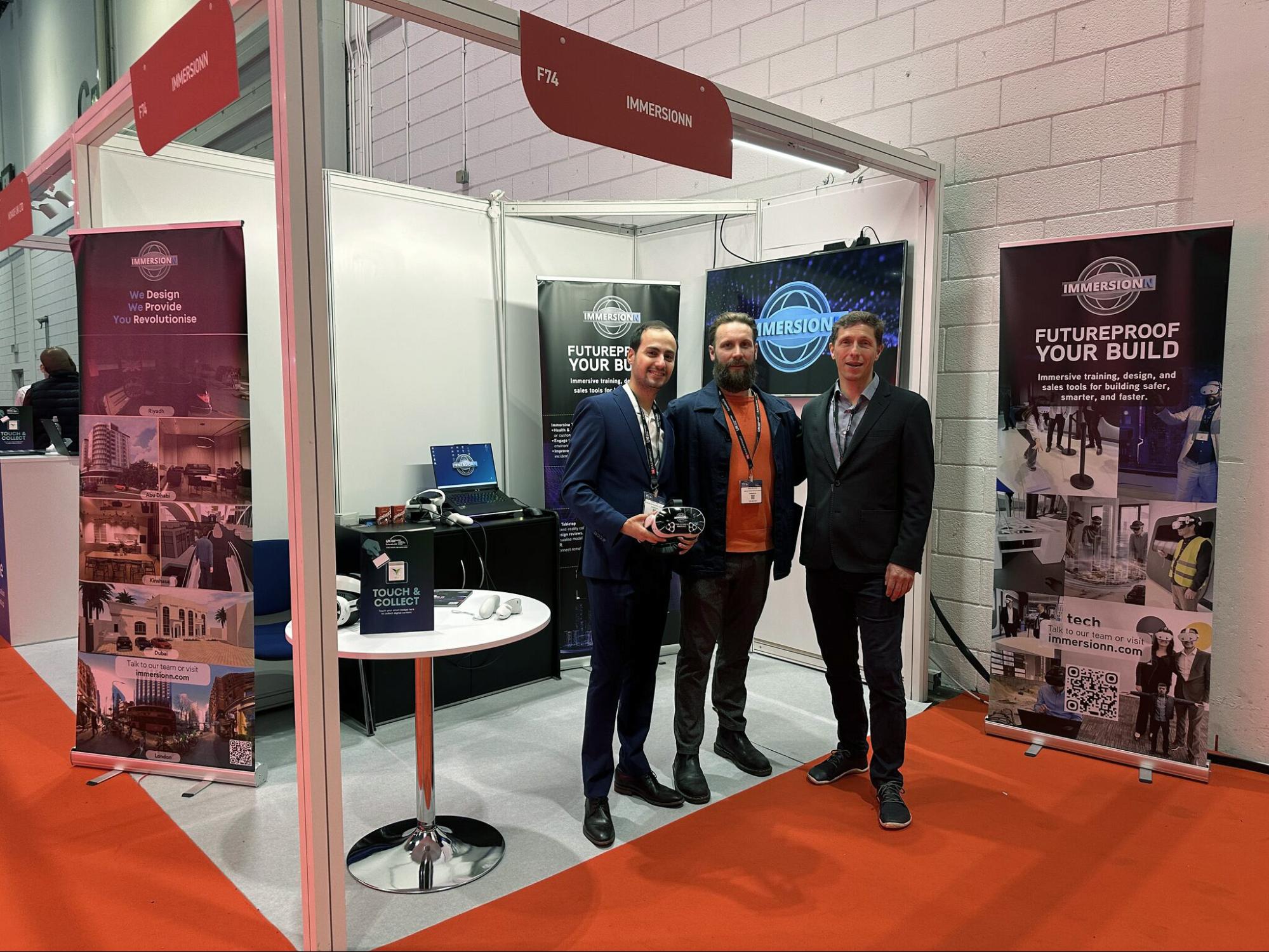
We took two solutions to UK Construction Week 2026. A real-time 3D visualisation suite that converts CAD models into immersive, navigable environments for design review and public consultation. And an XR safety training platform built around the specific hazards that kill construction workers: falls from height, plant proximity, confined spaces.
Two solutions. Two distinct audiences. One stand.
UKCW ran from 12 to 14 May at ExCeL London, the largest built environment event in the UK calendar. The case for being there was straightforward: 25,000 attendees, 600 exhibitors, three days of concentrated access to the industry. We went with clear objectives on both sides of our proposition and a live demo running throughout.
This is an honest account of what actually happened, including what the response on each side told us about where construction firms are in their technology adoption right now, and what we would do differently next time.
What the Show Floor Told Us About Safety Training
The HSE people were not in the room.
UKCW 2026 merged with Futurebuild and Stone and Surfaces to create a single event. The ambition is understandable. The effect on the audience profile was significant. The show floor was dominated by material suppliers, product manufacturers, and contractors looking at procurement rather than technology adoption. Health and safety professionals tend to be selective about the events they attend, gravitating towards shows where the content programme speaks directly to their remit. .
For a proposition built around safety outcomes, that matters. HSE Directors and Operations Managers do not browse exhibition floors the way procurement teams do. They attend events with a specific professional focus, where the content programme speaks directly to their responsibilities and where the other attendees share their frame of reference. UKCW in its current merged format attracts a broad construction audience, which suits some propositions better than others.
The talks programme was a different story entirely. The panels on workforce development, digital adoption, and safety culture were well attended and genuinely substantive. More importantly, they attracted exactly the kind of senior professionals we were trying to reach. Participating actively in the Q&A sessions following those talks, rather than waiting at the stand for the right person to walk past, turned out to be one of the most effective things we did across the three days. Several of the most valuable conversations we had started not on the stand but on the way out of a panel room.
That is a useful lesson in itself. In a show with a broad audience profile, the content programme is where the most focused conversations happen.
What the Show Floor Told Us About Visualisation
This is where the show delivered.
Our real-time 3D visualisation suite generated consistent, engaged enquiries across all three days, and the profile of the people asking questions was exactly what we had hoped for on that side of our proposition.
Four housing developers stopped at the stand. Not architects, not contractors: developers, the people making decisions about how sites get communicated, sold, and approved. The context is not hard to understand. The Labour government has set a target of 1.5 million net additional dwellings in England by 2029, requiring at least 300,000 new homes per year, a level that has not been achieved in modern UK history. Current delivery is running at around 196,500 dwellings per year, leaving the country on track to fall roughly 860,000 homes short of the target by the end of 2029. The pressure to move projects through planning, public consultation, and sales more efficiently is felt at every level of the residential development pipeline.
That pressure was visible in the conversations we had. The ability to take a CAD model and put a client, a planning committee, or a future resident inside it in real time is a genuinely different kind of conversation from a rendered image or a static visualisation. Several visitors described the same problem independently: getting community stakeholders to meaningfully engage with a development proposal when all you have to show them is a technical drawing. An immersive, navigable environment changes what is possible in that conversation.
The UK needs to build a lot of homes, faster than it currently is. That much was visible from the stand, and it confirmed that the appetite for better visualisation tools in residential development is real and growing.
The Messaging Problem
Two propositions. Two audiences. One stand. That combination has a cost.
Running both solutions under a single banner created confusion we had not fully anticipated. Visitors who arrived curious about visualisation were met with a demo environment that also referenced fall hazard scenarios and safety training. Visitors who arrived following up on safety conversations encountered residential development use cases that had no relevance to their brief. The problem is not that the two solutions are incompatible. They are both immersive technology applied to the built environment, and there is a coherent story connecting them. The problem is that coherence requires time and context to land, and a busy exhibition floor does not offer either.
Most stand conversations last three to five minutes. In that window, a visitor needs to understand immediately what you do and whether it is relevant to them. When the answer requires some context to land, the conversation can lose momentum before it has properly started. A safety professional would engage with the training proposition, notice the visualisation materials, and ask a clarifying question that took the conversation sideways. A developer would do the same in reverse. Neither outcome was fatal, but both cost time and occasionally cost the clarity of a conversation that had started with genuine intent.
The lesson is straightforward: two propositions targeting two different audiences need two different environments, separate demo flows, and ideally separate events.
What This Taught Us About How Construction Firms Are Buying Technology
The appetite is real. The pathway is specific.
The clearest read we took from three days at ExCeL is that construction firms are not buying technology generically. They are buying solutions to problems they are already feeling pressure around. The housing developers who stopped at the stand were not browsing for innovation. They were looking for a faster, more convincing way to move projects through planning and public consultation in a market where delivery timelines are under scrutiny. The problem was already live. The technology gave them a language to talk about solving it.
The safety training side told a different story, and not because the problem is less acute. Falls from height still kill more construction workers than any other single cause, every year, without exception. The issue is that the people responsible for solving that problem were not in the room. HSE Directors and safety managers attend events where safety is the primary focus, where the content programme speaks to their specific responsibilities and where the other attendees share their frame of reference. A large generalist construction show serves many purposes well, but specialist audiences require specialist events. .
Selling technology into construction requires meeting buyers where their problem is already active and where they are already in the mindset to act on it. The visualisation conversations happened organically because the housing pipeline pressure made the problem immediate. The safety training conversations will happen the same way, in the right room, with the right audience. For that side of our proposition, an event like Safety, Health and Wellbeing Live is a significantly better fit than UKCW in its current format. For our safety training proposition, an event like Safety, Health and Wellbeing Live is a better fit going forward.
There is also a longer game worth naming. Amanda Long, Chief Executive of Construction Products Information, made a point during one of the conference sessions that stayed with us: the most direct route to meaningful traction in UK construction is a proof case with a tier-1 contractor. A project with a firm like Mace, properly documented and evidenced, changes the conversation at every level below it. That is the pathway we are focused on.
If you are working on residential development projects and want to explore what real-time 3D visualisation could do for your planning and consultation process, or if you are responsible for safety training in UK construction and want to understand what immersive XR can actually deliver, we would welcome the conversation.
References
[1] Health and Safety Executive. Construction Statistics in Great Britain, 2025. HSE Accredited Official Statistics. hse.gov.uk/statistics/assets/docs/construction.pdf
[2] Full Fact. Is the government on track to deliver 1.5 million new homes? March 2026. fullfact.org/government-tracker/1-5-million-homes/
[3] Lanpro / PBC Today. Current delivery projections to only meet 1.5 million new homes target by half. October 2025. pbctoday.co.uk
[4] Global Centre on Healthcare and Urbanisation. Does the government’s target of 1.5 million new homes add up? November 2025. gchu.org.uk
[5] Construction Enquirer, April 2026. HSE targets construction with tougher incident reporting shake-up. constructionenquirer.com